
HYROX Training Club: What it is, how you train, and why it’s booming
1. What is HYROX? – An overview
HYROX is a globally standardized indoor fitness race, founded in 2017 in Hamburg by Olympic hockey champion Moritz Fürste and Christian Toetzke. Since the first official competition in 2018, the format has developed into the fastest-growing fitness movement in the world – with over one million athletes and more than 9,000 accredited HYROX Training Clubs worldwide.
The concept: 8 km of running + 8 functional workout stations: alternating, always in the same order, and identical worldwide. This makes global comparisons and clear performance measurement possible.
What makes HYROX special: The format is 100% standardized. Every participant, whether in Cologne, London, or Miami, completes exactly the same race. This enables global leaderboards and a transparent performance tracking system. At the same time, HYROX is designed for all fitness levels. The exercises do not require advanced technical skills; the focus is on strength endurance, pace, and mental resilience.

2. What is a HYROX Training Club?
A HYROX Training Club is an officially accredited fitness studio that is authorized to offer HYROX training and use the HYROX brand. These clubs form the backbone of the global HYROX community – they are the place where athletes train, prepare, and build a community.
These EVO clubs are official HYROX Training Clubs (as of April 15, 2026):
- Berlin Spittelmarkt: Go to club page
- Hamburg Stadthausbrücke: Go to club page
- Dresden: Prager Str.: Go to club page
- Köln Ehrenstr.: Go to club page
Learn more about HYROX at EVO
GO TO OVERVIEW PAGE2. The 8 HYROX stations in detail
Every HYROX race follows the same sequence: 1 km run → Station 1 → 1 km run → Station 2 → ... → Station 8 → finish line. In total, 8 km are run and 8 functional workout stations are completed. In between, there is an average transition distance of around 700 m in the so-called Roxzone.
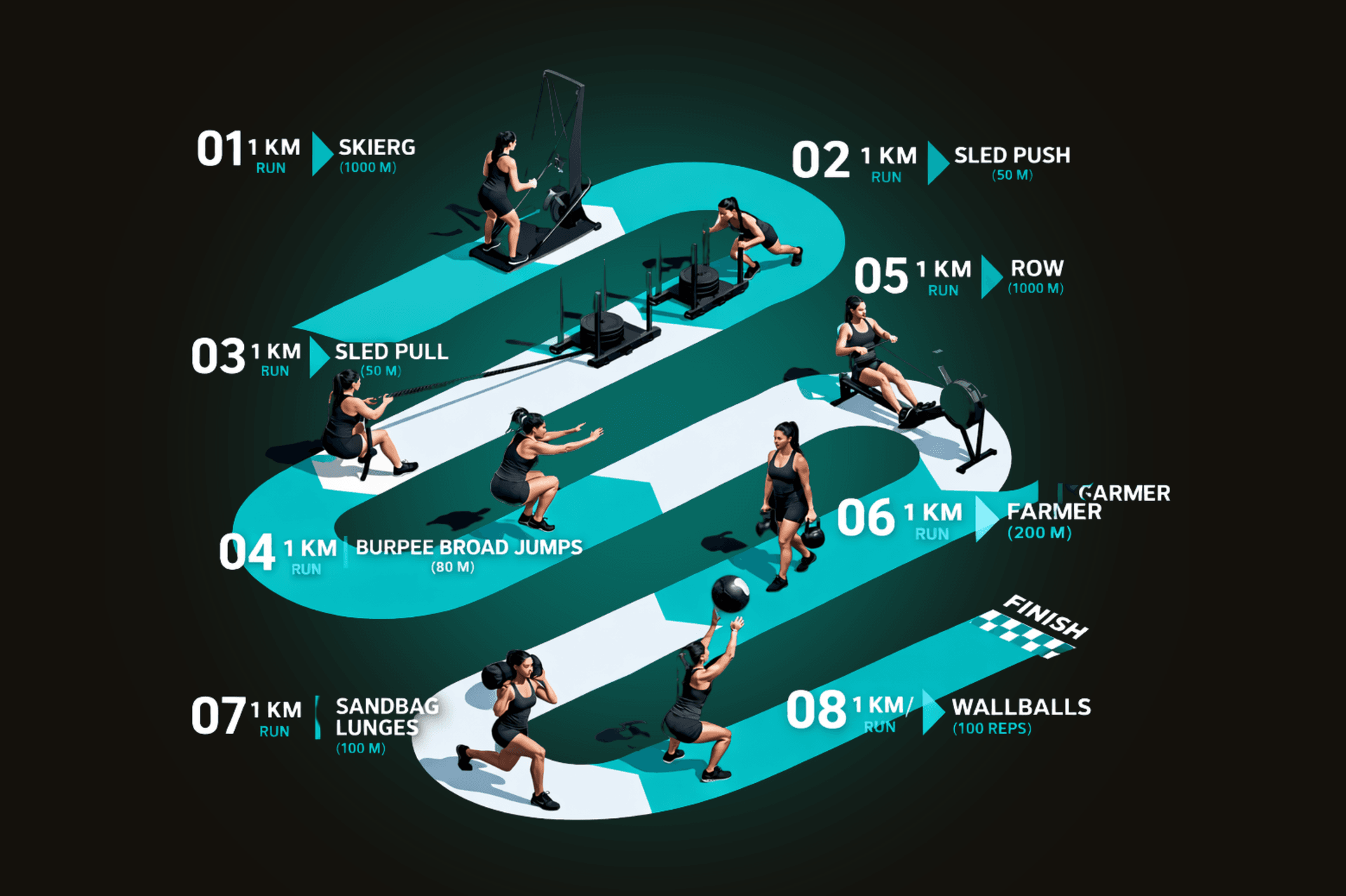
| # | Station | Distanz / Wiederholungen | Gewicht |
|---|---|---|---|
| 1 | Ski Erg | 1.000 m | — |
| 2 | Sled Push | 4 × 12,5 m | 102 kg / 152 kg |
| 3 | Sled Pull | 4 × 12,5 m | 102 kg / 152 kg |
| 4 | Burpee Broad Jump | 80 m | Körpergewicht |
| 5 | Rowing | 1.000 m | — |
| 6 | Farmers Carry | 200 m |
Damen: 16 kg (Open), 24 kg (Pro)
Herren: 24 kg (Open), 32 kg (Pro)
Mixed: 24 kg
|
| 7 | Sandbag Lunges | 100 m |
Damen: 10 kg (Open), 20 kg (Pro)
Herren: 20 kg (Open), 30 kg (Pro)
Mixed: 20 kg
|
| 8 | Wall Balls | 100 Wdh. | 4–6 kg / 6–9 kg |
Note on weights: The values shown refer to the Open division. Pro and Elite divisions have different requirements. The order of the stations is fixed and identical at every event worldwide.
4. 4HYROX Training – Structured for Success
Many athletes make the same mistake when training for HYROX: they complete too many high-intensity HYROX workouts and neglect basic endurance and systematic strength development. Effective HYROX training is based on four pillars:
The four training pillars
Zone 2 training, threshold, and VO₂max sessions. Around 50% of race time is spent running — endurance is therefore just as important as strength..
Fundamental exercises such as squats, deadlifts, and rowing variations — for efficient movement at the stations under fatigue.
A combination of strength endurance, cardiovascular load, and mental toughness — the ability to perform consistently under fatigue.
The interplay of running and stations: compromised running, pacing, transitions, and station-specific technique.
Vimeo Content
This Vimeo content can only be loaded once you consent to the cookie settings for external content.
The 12-Week Training Plan at a Glance
A structured 12-week plan is the most effective way to prepare for HYROX — divided into four phases, each with its own focus:
| Phase | Weeks | Fokus | Sessions per Week |
|---|---|---|---|
| Phase 1: Fundament | 1 – 4 | Strength development & base endurance (Zone 2), learning technique | 3 – 4 |
| Phase 2: Build | 5 – 8 | Interval training, HYROX-specific stations, higher volume | 4 – 5 |
| Phase 3: Peak | 9 – 11 | Race simulations, pacing strategy, combination workouts | 4 – 5 |
| Phase 4: Tapering | 12 | Reduced load, technique refinement, mental preparation | 2 – 3 |
Example Training Week (Mid Phase)
- Monday: Lower body strength: deadlifts, lunges, wall balls + 20 min Zone 2 run
- Tuesday: Running intervals: 5 × 1,000 m at race pace, 90 sec rest
- Wednesday: Upper body & grip strength: rowing, farmer’s carry, lat pulldowns
- Thursday: Active recovery: mobility, foam rolling, light jogging
- Friday: HYROX combo workout: 3–4 stations + running blocks (race simulation)
- Saturday: Long base run: 45–60 min in Zone 2
- Sunday: Recovery
⚠️ Most common mistake: Too many high-intensity sessions, too little base endurance. If you want to seriously aim for a sub-60-minute finish, you’ll need 4–5 sessions per week — with a well-balanced mix of intensities.
5. Who is HYROX for?
HYROX describes itself as “A Sport for Everybody” — and rightly so. The minimum age is 16, and there is no upper age limit. The divisions are designed so that both beginners and professionals can take part:
- Open: For beginners and recreational athletes, recommended entry level
- Pro: Higher weights and more demanding standards for advanced athletes
- Elite: Professionals aiming for top performance and competition at the highest level
- Doubles: Two people share the exercises — ideal for team training
- Relay: Teams of four — maximum community fun
- Age Groups: Rankings by age group for fair comparisons
Especially important: All exercises can be scaled in terms of weight, intensity, and execution. Even if you’ve never done HYROX before, you don’t need to be a top athlete — the movements are functional and can be learned by anyone.
FEEL LIKE TRYING HYROX FOR YOURSELF?
BOOK A FREE TRIAL SESSION6. Key Tips for Getting Started
5 things you should definitely keep in mind during your preparation:
HYROX doesn’t just challenge your body — your mind needs to be trained as well. Pros focus on:
- Visualization: Mentally rehearsing all stations and transitions
- Segmentation: Breaking long stations into smaller chunks (“just 25 wall balls left”)
- Self-talk: Clear, focused cues under fatigue
No progress without recovery. Key strategies:
- Sleep: Mind. 8 Stunden, idealerweise mit HRV-Tracking
- Cold exposure: Cold plunges or cold showers to reduce inflammation
- Mobility: Focus on hips, shoulders, and back
- Aktive Erholung: Light jogging or cycling instead of complete rest
Shoe choice is often underestimated. For HYROX, stable training shoes with good grip are essential. Shoes that are too soft can increase the risk of injury during exercises like the sled push or farmer’s carry. Functional cross-training shoes are ideal.
For races (70–120 min), keep the following in mind:
- A carbohydrate-rich diet 48 hours before the race
- Adequate hydration
- No new foods on race day
- Small gels can help support performance during the race
7. Frequently Asked Questions (FAQ)
What is HYROX?
HYROX is a fitness race format that combines running with functional workout stations. It brings together endurance, strength, and race-specific intensity in a structured format.
Who is HYROX training suitable for?
HYROX training is suitable for anyone looking to specifically improve their endurance, strength, and work capacity — from ambitious beginners to competition-focused athletes..
Which training areas are particularly important?
Endurance, strength, work capacity, and the HYROX-specific combination of running, pacing, transitions, and station technique are especially important.
How often should I train per week?
Depending on the training phase, 3 to 5 sessions per week are generally recommended. During the tapering week, training volume is reduced to ensure you’re well-rested for race day..
Conclusion
HYROX is more than just a trend: it is a structured, scalable, and globally measurable fitness challenge that is equally suitable for beginners and competitive athletes. A HYROX Training Club is the ideal place to prepare in a targeted way: with certified coaches, specialized equipment, structured programming, and a community that motivates and supports you.