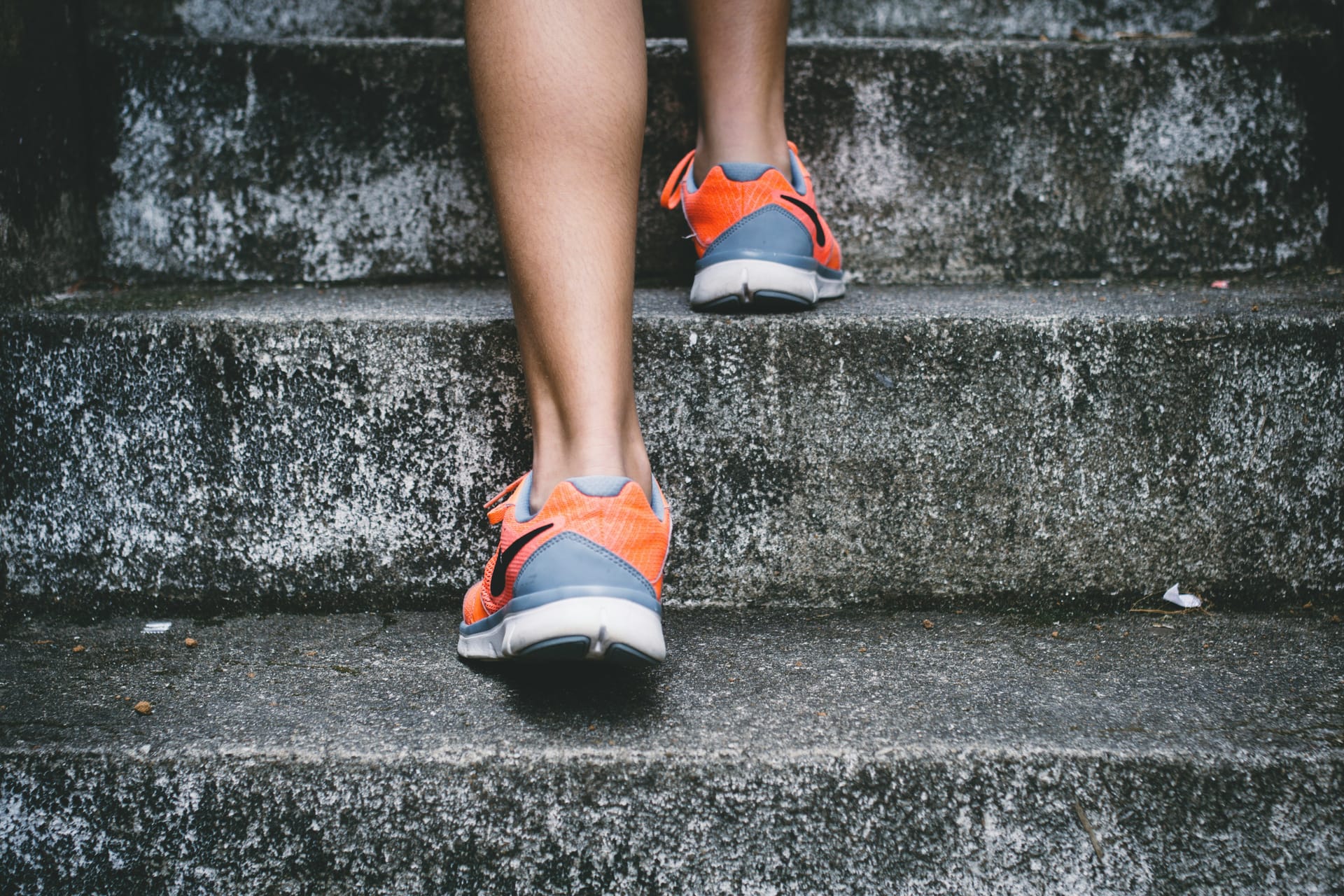
How many steps per day are healthy?
The current state of research – and why the 10,000-step rule is a myth
Almost everyone knows the recommendation: 10,000 steps per day for a healthy life. However, this number doesn’t come from science — it originated from a Japanese marketing campaign in 1965. What current research shows is far more nuanced, encouraging, and for many people easier to achieve.
This article summarizes the state of knowledge as of 2025, including one of the largest meta-analyses of all time, recommendations by age group, and an often overlooked factor: not just how many steps you take, but how you take them.
1. Where does the 10,000-step rule come from?
In 1964, the Olympic Games took place in Tokyo, and Japan was experiencing a fitness boom. The company Yamasa capitalized on this trend and launched a pedometer called Manpo-kei. The name simply means “10,000-step meter” in Japanese. No study. No doctor. Just a catchy number on a product package.
This number spread globally and was misunderstood for decades as a scientific recommendation. Since around 2019, the research community has been systematically correcting this myth. The result: the health benefits start much earlier, and for many groups, different targets make more sense.
2. What does current research say?
The evidence today is clearer than ever before. Two studies from 2023 and 2025 are particularly groundbreaking:
In July 2025, one of the most comprehensive analyses on this topic was published in the renowned journal The Lancet: 57 individual studies were evaluated.
Result: As few as 5,000 to 7,000 steps per day already have a clearly positive effect in many areas of health. More steps provide additional benefits — but the returns diminish.
An international study with data from around 227,000 people shows:
- +500 steps per day reduce the risk of fatal cardiovascular disease
- +1,000 steps reduce overall mortality risk by approx. 15%
- Measurable health benefits begin at around 4,000 steps
An analysis involving over 85,000 participants from the UK Biobank shows:
7,000 steps per day are associated with a significantly reduced risk of cancer.
Researchers at the Universidad Europea de Madrid show that those who accumulate their steps in longer, continuous blocks — rather than many short interruptions — benefit more.
Shorter but uninterrupted walking sessions are associated with a lower risk of mortality and cardiovascular disease. This supports the idea of going for a purposeful walk instead of relying on constant small movements throughout the day.
3. How many steps per day: by age group
There is no universal target that fits everyone. Age, fitness level, and overall health play a crucial role. Here are evidence-based guideline ranges:
| Age Group | Recommendation | Minimum | Note |
|---|---|---|---|
| Children (6–12 J.) | 10.000–12.000 | 8.000 | Children naturally move more; active play counts |
| Teenagers (13–17 J.) | 8.000–10.000 | 7.000 | 60 minutes of activity per day recommended; steps are a good proxy |
| Adults (18–64 J.) | 7.000–10.000 | 5.000 | Clear health benefits from 7,000 steps; optimal range 8,000–10,000 |
| Seniors (65+ J.) | 5.000–8.000 | 4.000 | As few as 2,600–3,000 steps measurably reduce mortality risk |
| Weight Loss Goal | 12.000–13.000 | 10.000 | Health insurers recommend 13,000 + 300 min of moderate activity per week |
Important: These values are guidelines, not limits. Prof. Christine Joisten from the German Sport University Cologne puts it succinctly: Those who have been inactive will already benefit from a slight increase in their step count — and the effect is even greater the less active you have been.
4. Not just how many, but how you walk
This aspect is missing from most popular articles on the topic. Research shows that how you walk has a significant impact on the health benefits.
Pace makes the difference
Brisk walking — a pace where you’re slightly out of breath but can still hold a conversation — is significantly more effective than a leisurely stroll. During brisk walking, your heart rate increases, your cardiovascular system is trained more effectively, and your calorie burn rises noticeably.
| Walking Speed | Health Effect |
|---|---|
| Slow (<4 km/h) | Basic activation, good for complete beginners |
| Moderat (4–5 km/h) | Recommended as a daily baseline, easy to sustain |
| Brisk (5–6 km/h) | Clear cardiovascular benefits, increased calorie burn |
| Fast (>6 km/h) | Training effect comparable to light jogging |
Walking continuously – the block advantage
As mentioned above: someone who takes a continuous 30-minute walk benefits more than someone who spreads the same number of steps across 10 blocks of 3 minutes throughout the day. This doesn’t mean short bouts of activity are worthless — but a deliberate, longer walk provides a measurable additional benefit.
Breaking up sitting counts separately
Regardless of your daily step count, the following applies: if you stand up every 30–60 minutes and move for 2–3 minutes, you can measurably improve insulin sensitivity, lower inflammatory markers in the blood, and reduce the risk of back pain. These aren’t steps that necessarily show up in an app — but your body still registers the difference.
5. Why getting enough steps is so healthy
Regular walking is one of the few interventions proven to reduce the risk of a wide range of chronic diseases — without side effects, without costs, and without equipment.
Physical effects
- Cardiovascular system: Lower blood pressure, resting heart rate, and LDL cholesterol
- Type 2 diabetes: Improved insulin sensitivity and more stable blood sugar levels
- Cancer risk: 7,000 steps per day are associated with a significantly reduced cancer risk (2025)
- Osteoporosis: Walking places controlled stress on bones and stimulates bone formation
- Musculature: Activation of legs, core, and — with active arm swing — the upper back
- Overweight: Increased baseline energy expenditure through more daily movement (NEAT effect)
Mental and psychological effects
This aspect is often overlooked in many guides, even though it is strongly supported by scientific evidence:
- Mood: Walking releases endorphins and serotonin. Effects can be felt after just 10–20 minutes
- Stress: Cortisol levels measurably decrease after a walk; nature further enhances this effect
- Depression: Meta-analyses show that regular walking can have effects similar to low-dose antidepressants
- Anxiety disorders: Physical activity reduces activation levels of the nervous system
- Cognition: Improved blood flow to the brain, enhanced concentration and memory performance
- Dementia prevention: Regular movement is one of the strongest known protective factors
Walking alone is good. Walking combined with strength training is even better.
Building muscle increases your metabolism and helps your body burn more calories — even at rest.
If you combine 7.000 Steps per day with 2–3 strength workouts per week you unlock the full potential of both approaches.
Start now with a no-obligation trial session at one of our studios in Hamburg, Berlin, Cologne, Düsseldorf, Dresden, Munich, or Wiesbaden.

Walking + strength training is the ideal combination
6. Steps to lose weight: What really works
Many people consciously walk more to lose weight. That’s a good approach—but with realistic expectations.
Calorie burn from walking
A person weighing 70 kg burns approx. 4–5 kcal per minute while walking. That means around 280–350 kcal for 7,000 steps (approx. 70 minutes). This is equivalent to a small lunch — no more, no less.
Conclusion: If you don’t change your diet but increase your daily steps to 7,000–10,000, you can realistically lose about 0.3 kg per month from walking alone. If you also adjust your diet and add strength training, you can accelerate this significantly.
Read hier what measures can help you lose weight faster.
Recommendation for weight loss
The German Society for Sports Medicine and Prevention (DGSP) recommends for targeted weight loss: 13,000 steps per day combined with at least 300 minutes of moderate physical activity per week. This is demanding, but it shows that walking alone does not replace a full weight loss program. Want to do more? Book a free trial session kostenfreies Probetraining at EVO Fitness and build a sustainable fitness routine.
The NEAT effect: everyday activity as a calorie burner
NEAT (Non-Exercise Activity Thermogenesis) refers to all calories burned through daily movement outside of structured exercise. This includes steps. Studies show that NEAT can vary daily energy expenditure by 200 to 600 kcal. People who move a lot in everyday life therefore have a significantly higher calorie burn — not because of workouts, but because of their habits.
7. How to integrate more steps into your daily life
Daily life is busy. The best approaches aren’t additional activities — they are habit adjustments that naturally fit into your routine.
Quick and effective
- Take the stairs instead of the elevator — consistently, even if it’s just one floor
- Get off one stop earlier or park your car farther away
- Use your lunch break for a 20-minute walk — continuously, ideally outdoors
- Take phone calls while standing or walking
- Use a standing desk: reduces sitting time and increases NEAT
Habits instead of intentions
Sports and exercise scientist Sylvia Titze from the University of Graz recommends: set fixed rules instead of making individual decisions. For example: I walk to work every second day, or I always take the stairs if it’s no more than two floors. This helps the brain avoid having to choose between convenience and health every time.
Scheduled walks with friends, walking groups, or using the EVO treadmill EVO Laufbands on rainy days are also proven ways to reliably incorporate more steps into your daily routine.

Treppe statt Aufzug – konsequent, auch wenn es nur ein Stockwerk ist
8. Track your steps – the best tools 2025
Tracking itself is motivating: those who see their steps are proven to walk more. Here are the current options:
| Tool | What it does |
|---|---|
| Apple Health / iPhone | Automatic tracking without additional devices; calories, distance, and trends over weeks and months |
| Google Fit / Health Connect | Android equivalent; connects all health-related apps in one dashboard |
| Apple Watch (alle Modelle) | Accurate tracking, heart rate, ECG, blood oxygen; Ultra model for sports enthusiasts |
| Garmin (Forerunner, Instinct) | Very high accuracy for runners; GPS tracking, long battery life, HYROX-compatible |
| Fitbit / Google Pixel Watch | Slim design, sleep tracking, stress level monitoring; good value for money |
| Samsung Galaxy Watch | Strong Android integration; body composition, many sports modes |
| Polar (Ignite, Pacer) | Highly accurate heart rate tracking, AI-driven training insights, and long battery life |
| No device (rule of thumb) | 10 minutes of walking ≈ 1,000 steps; 75 minutes per day ≈ 7,500 steps |
New AI features 2024/2025: More and more wearables use machine learning not only to count steps but also to provide personalized recommendations, e.g. when the optimal time for a walking break is or whether your walking pace is sufficient to achieve the desired health effect.

People who track their steps are proven to walk more
9. Myth check: What’s true and what’s not
10. Conclusion: More steps, healthier life
The question of how many steps per day are healthy has a clearer answer in 2025 than ever before: from around 7,000 steps per day, clear and scientifically proven health benefits begin — for the heart, metabolism, mental health, and longevity. Those who manage less still benefit from every additional step. Those who do more gain even greater benefits.
Three key points are crucial and often missing in many articles: First, quality matters — walking briskly and continuously yields better results. Second, the optimal target depends on age. Seniors already benefit greatly from around 4,000 steps, while those aiming to lose weight should target around 13,000. And third: walking is good — walking plus strength training is better.
Bad weather? Short on time? In our EVO Fitness studios, you’ll find modern treadmills and cross trainers, so you can reach your step goal indoors as well.
Combine your steps with targeted strength trainin – and unlock the full potential of everyday movement and gym training.
Quellen & Studien
- Banach et al. (2023): Lancet-Metastudie Schritte und Sterblichkeit, 227.000 Teilnehmende
- The Lancet Public Health (Juli 2025): 57-Studien-Metaanalyse zu Schrittzielen und Gesundheit
- British Journal of Sports Medicine (2025): 7.000 Schritte und Krebsrisiko, UK Biobank (n=85.394)
- Universidad Europea de Madrid (2025): Bewegungsblöcke vs. verteilte Schritte, Herz-Kreislauf-Risiko
- Deutsche Gesellschaft für Sportmedizin und Prävention (DGSP): Empfehlungen zur körperlichen Aktivität
- Prof. Christine Joisten, Deutsche Sporthochschule Köln: Kommentar zu Schrittstudien
- WHO: Globale Empfehlungen zu körperlicher Aktivität und Gesundheit
- Techniker Krankenkasse / BARMER / AOK / DAK: Aufbereitung aktueller Studien (2024–2025)
Dieser Artikel ersetzt keine medizinische Beratung. Bei gesundheitlichen Beschwerden oder starkem Übergewicht bitte ärztlichen Rat einholen.